Level 2 Charger Amps (Amps, kW and Breaker Size)
Enter a charger's amps, its kW or your breaker size to see the power, the breaker it needs and the range it adds each hour.
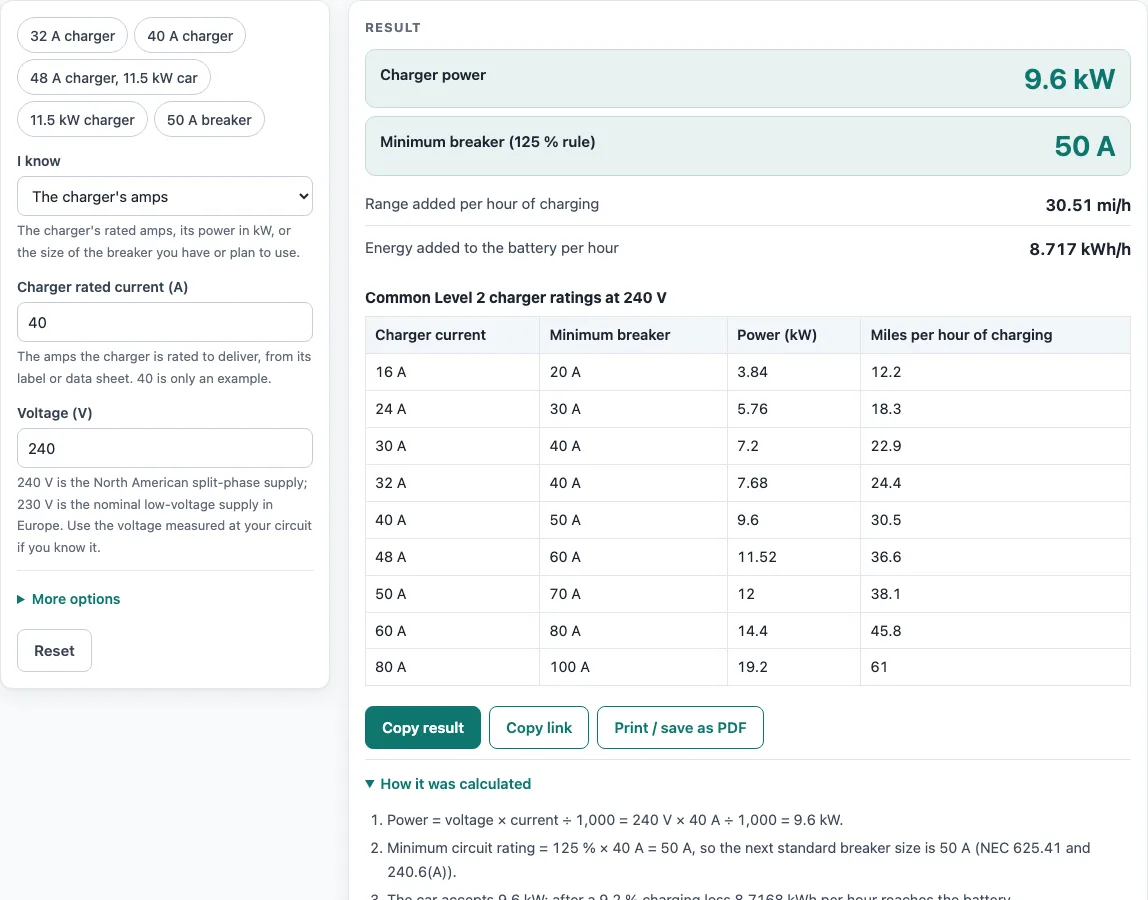
How to use the Level 2 charger amps calculator
- Open the “I know” drop-down and choose what you have: The charger’s amps, The charger’s kW or My breaker size.
- Type the matching value into the field that appears: Charger rated current (A), Charger power (kW) or Breaker size (A). Take the number from your charger’s label or data sheet.
- Check the Voltage (V) field. Keep 240 V for a North American supply or 230 V for Europe, or enter the voltage measured at your circuit if you know it.
- Optional: open More options. Enter the Car’s onboard charger limit (kW) if you know it, keep the Charging loss (%) at its 9.2 % default or enter your own estimate, and type your Car efficiency with its unit, such as 3.5 mi/kWh, to get miles per hour.
- Read the result rows: charger current, charger power, minimum breaker, highest charger current that breaker allows, power the car accepts, energy added per hour and range added per hour. Rows that do not apply to your chosen mode are hidden.
- Read any warning shown below the results, then compare your numbers with the common ratings table.
The example buttons above the form load a 32 A, 40 A and 48 A charger, an 11.5 kW charger and a 50 A breaker. Copy result copies the result lines with a link, and Copy link stores every input in the page address so the same calculation reopens later. Print / save as PDF prints the inputs, results, steps and date. Reset restores the starting example.
How many kW is a level 2 charger?
A Level 2 charger’s power in kW equals its voltage multiplied by its amps, divided by 1,000. On a 240 V circuit, a 16 A charger is 3.84 kW, a 32 A charger is 7.68 kW and a 48 A charger is 11.52 kW.
The formula also works in reverse: kW × 1,000 ÷ volts gives amps. For example, 11.5 kW at 240 V is about 47.92 A. The same 40 A charger produces 9.6 kW at 240 V but 9.2 kW at 230 V, so use the voltage that applies to your circuit.
How many amps is a level 2 charger?
A Level 2 charger’s amps are set by its rating, which is printed on its label or data sheet. The SAE J1772 standard’s AC Level 2 range tops out at 80 A, which is 19.2 kW at 240 V. The table under the result lists 16, 24, 30, 32, 40, 48, 50, 60 and 80 A; check your own charger’s label for its rating.
What size breaker do I need for a 40 amp EV charger?
You need a 50 amp double-pole breaker. An EV charger counts as a continuous load, so its circuit and breaker must be rated at at least 125 % of the charger’s current. For a 40 A charger, 40 × 1.25 = 50 A, which is already a standard breaker size.
A 50 A breaker allows the charger to draw up to 80 % of its rating, which is 40 A. That is exactly the 40 A charger’s rating, so the pair fits. The same 40 A charger delivers 9.6 kW at 240 V. A 32 amp charger needs a 40 A breaker, since 32 × 1.25 = 40 A exactly.
What size breaker do I need for a 48 amp charger?
You need a 60 amp breaker. A 48 A charger needs 48 × 1.25 = 60 A, which is a standard size, and at 240 V the charger then delivers 11.52 kW.
Check the breaker size before you buy a charger, because a larger breaker does not raise the charger’s own limit. The breaker only sets the maximum the circuit can carry.
Can a 50 amp breaker run a 48 amp charger?
No. A 50 amp breaker allows at most 80 % of its rating, which is 40 A, so a 48 A charger would overload it. You can set the calculator to My breaker size of 50 A to see the highest charger current it allows.
For a 48 A charger, use a 60 A breaker. For a 50 A breaker, choose a charger rated at 40 A or lower.
Worked examples
| Input | Result |
|---|---|
| 40 A at 240 V | 40 A, 9.6 kW, breaker 50 A |
| 32 A at 240 V | 32 A, 7.68 kW, breaker 40 A |
| 48 A at 240 V | 48 A, 11.52 kW, breaker 60 A |
| 11.5 kW at 240 V | 47.92 A, 11.5 kW, breaker 60 A |
| 60 A breaker at 240 V | 48 A, 11.52 kW, breaker 60 A |
Calculated by the tool above with these values.
Frequently asked questions
How many miles per hour does a level 2 charger add?
Range added per hour equals the kW the car accepts, multiplied by (1 minus the charging loss), multiplied by the car’s efficiency in miles per kWh. With the calculator’s default values of 9.2 % loss and 3.5 mi/kWh, a 40 amp charger adds about 30.5 miles per hour and a 32 amp charger about 24.4 miles.
Does a bigger level 2 charger always charge my car faster?
No. The car’s onboard charger limits the AC power it accepts, so a 48 A (11.52 kW) charger delivers only 11.5 kW to a car with an 11.5 kW limit. Enter the car’s limit under More options, and check your car’s manual, because many cars accept less than the highest chargers offer.
What is the highest current a Level 2 charger can use?
The top of the SAE J1772 AC Level 2 range is 80 A, or 19.2 kW at 240 V. The calculator shows a warning for any value above 80 A, so check the input if you see it.
Does this calculator size the wire or check my home’s electrical service?
No. The calculator covers amps, kW, breaker size and range per hour only. Use the EV charger wire size calculator for wire and the EV charger load calculator for load, and have a licensed electrician verify any installation.
Related tools
- EV charger wire size calculator: use it once you know the breaker size and need the wire for the run.
- EV charger load calculator: use it to check how a charger adds to the load on your home’s electrical supply.
- EV charging time calculator: use it to estimate how long a full charge takes at a given kW.
- EV plug types chart: use it to confirm which connector your car and charger need.
- kWh to watts converter: use it to convert energy and power units when your charger or car lists them differently.
- All EV calculators: use it to browse every calculator on the site.
Sources
- Washington State University Energy Program, Charging speeds, ports and specs: SAE J1772 AC Level 2 up to 80 A, 19.2 kW
- Idaho National Laboratory, INL/EXT-12-25761: Level 2 overall charging efficiency 90.8 % (Chevrolet Volt), the default charging loss of 9.2 %
- NFPA 70, National Electrical Code: sections 625.41 and 240.6(A) cited; no tables reproduced