EV Versus Gas Calculator
Enter your yearly miles, fuel economy and prices to compare charging an EV with filling a gas car.
How to use the EV vs gas calculator
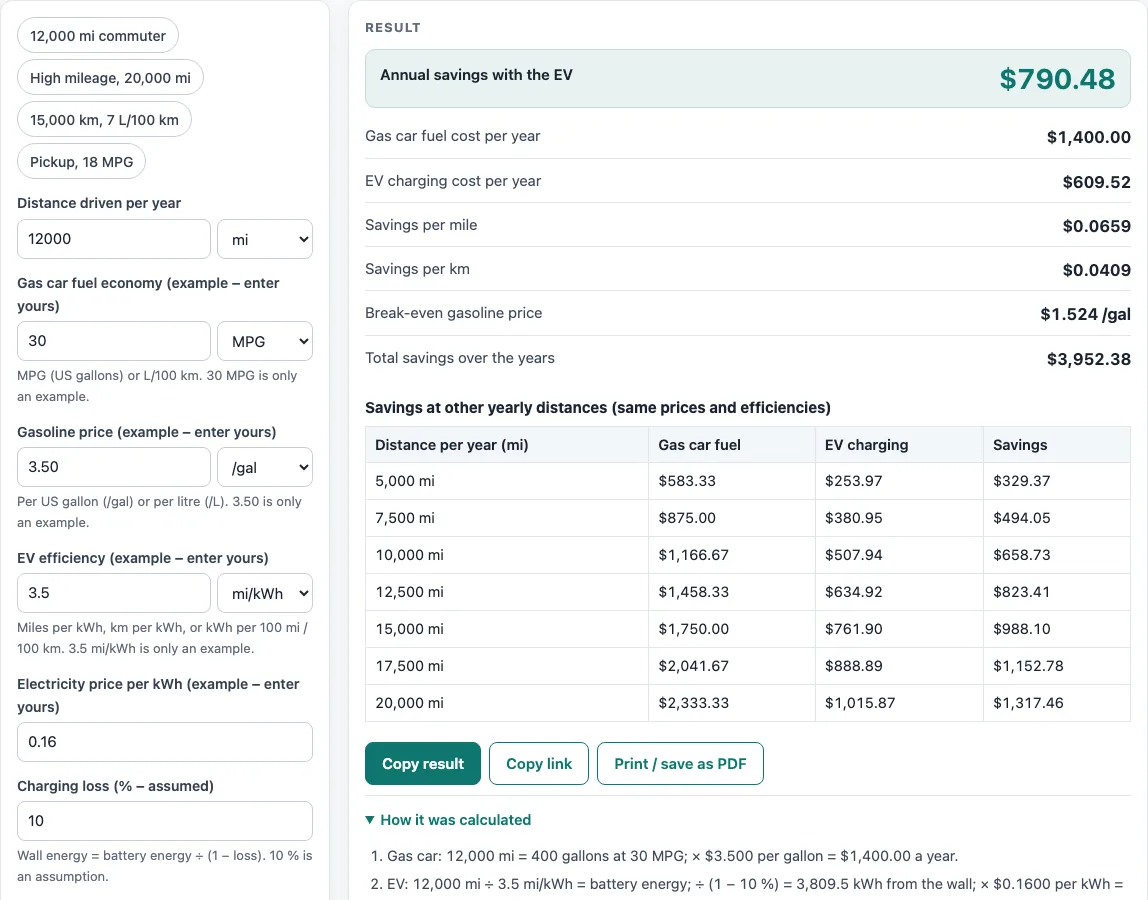
- Optional: press one of the example buttons above the form, such as “11,100 mi (U.S. average)” or “Pickup, 18 MPG”, to load a starting point. Otherwise, enter your own values.
- Enter the distance driven per year in miles or kilometres.
- Enter your gas car’s fuel economy in MPG or L/100 km. The 30 MPG value is only an example.
- Enter the gasoline price per US gallon (/gal) or per litre (/L). The 4.35 default is the EIA U.S. regular gasoline price for the week of 5 October 2026.
- Enter your EV’s efficiency in mi/kWh, km/kWh, kWh/100 mi or kWh/100 km.
- Enter the electricity price per kWh.
- Check the charging loss. The 9.2 % default comes from an Idaho National Laboratory Level 2 test; change it if you know your own figure.
- Open “More options” to choose a currency symbol ($, €, £ or none). To multiply the yearly saving, enter a number in “Years (optional)”. Leave it empty to skip this.
- Read the results. Only the rows that apply to your chosen mode are shown.
- Open “How it was calculated” to see the formula and each step with your numbers.
Metric mode uses L/100 km, km per year and price per litre. Copy result copies the result lines with a link, and Copy link stores every input in the page address, so the same calculation reopens later. Print / save as PDF saves inputs, results, steps and the date. Reset restores the starting example.
Is an electric car cheaper to run than a gas car?
The answer depends on your numbers. An electric car is cheaper to run when the electricity it uses per mile costs less than the gasoline a gas car burns over the same distance.
The gas car’s yearly fuel cost is annual miles ÷ MPG × gas price. For 11,100 miles (the FHWA 2023 average for a U.S. light-duty vehicle, rounded) at 30 MPG and $4.35 per gallon, the car uses 370 gallons, which is $1,609.50 a year.
How much money do you save with an EV?
Your yearly saving is the gas car’s fuel cost minus the EV’s charging cost. The EV’s energy use is annual miles ÷ mi/kWh ÷ (1 − charging loss), and that figure is multiplied by the electricity price. The loss term is needed because the wall energy you pay for is larger than the energy that reaches the battery.
With 3.5 mi/kWh, 9.2 % loss and $0.18 per kWh, the EV draws about 3,493 kWh a year from the wall, costing about $629. That leaves a saving of about $981 a year.
How do I compare EV and gas costs?
Compare the two costs on the same basis: the same yearly distance, one currency, and annual totals. If your EV efficiency is given as kWh per 100 miles, the tool accepts it directly, and 28.6 kWh/100 mi is the same as 3.5 mi/kWh (100 ÷ 3.5 ≈ 28.6).
Savings per mile is the annual saving divided by the annual distance. This helps when you want to compare a car with a different yearly mileage.
At what gas price does an EV save money?
An EV saves money at any gasoline price above the break-even gasoline price, which is the price where both cars cost the same to run. The break-even price is the EV’s annual cost × MPG ÷ annual miles.
In the starting example, the EV costs about $629 a year, so the break-even price is about $1.70 per gallon. If the gas price is below that, the calculator shows a warning that the gas car is cheaper to fuel.
Worked examples
| Input | Result |
|---|---|
| 11100 mi; gas car 30 MPG at $4.35/gal; EV 3.5 mi/kWh at $0.180 per kWh | $980.80 saved a year (gas $1,609.50 vs EV $628.70) |
| 20000 mi; gas car 30 MPG at $4.35/gal; EV 3.5 mi/kWh at $0.180 per kWh | $1,767.21 saved a year (gas $2,900.00 vs EV $1,132.79) |
| 11100 mi; gas car 18 MPG at $4.35/gal; EV 3.5 mi/kWh at $0.180 per kWh | $2,053.80 saved a year (gas $2,682.50 vs EV $628.70) |
| 15000 km; gas car 7 L/100 km at €1.80/L; EV 17 kWh/100 km at €0.300 per kWh | €1,047.49 saved a year (gas €1,890.00 vs EV €842.51) |
Calculated by the tool above with these values.
Frequently asked questions
Is an electric car cheaper to run than a gas car?
It is when electricity costs less per mile than gasoline does at your prices. The calculator only compares fuel and electricity, so purchase price, maintenance and insurance are covered by the total cost calculator.
How much money do you save with an EV?
Your saving is the “Annual savings with the EV” result. Enter a value in “Years (optional)” to multiply it, with no discounting and no change in prices.
How do I compare EV and gas costs?
Enter the same yearly distance for both cars, use one currency, and check the “How it was calculated” section. It lists each step with your numbers, so you can confirm the result.
At what gas price does an EV save money?
An EV saves money at any gas price above the break-even gasoline price shown in the results. Below that price, the tool warns that the gas car is cheaper to fuel.
Can I use the results in a quote or report?
Yes. Results, charts and printouts may be used freely in commercial work such as quotes, proposals, reports and service records, and no attribution is needed. The tool’s note still applies: it is for estimation, so verify critical designs against the applicable standard.
Related tools
- EV total cost calculator: Use it when you want to include purchase price, maintenance and insurance, not just fuel and electricity.
- EV cost per mile calculator: Use it when you want to see the running cost of each mile driven.
- EV charging cost calculator: Use it when you want to work out what a charging session or a set of charges costs.
- Hybrid gas savings calculator: Use it when you are comparing a hybrid car with a gas car.
- EV efficiency calculator: Use it when you need to convert or work out your EV’s efficiency before entering it here.
- EV lease calculator: Use it when you are leasing an EV and want the monthly payment and total lease cost.
- All EV calculators: Use it when you want to browse every calculator on the site.
Sources
- EIA Electric Power Monthly, Table 5.6.A: U.S. average residential price, July 2026 (18.31 ¢/kWh)
- EIA gasoline and diesel fuel update: U.S. regular retail price, week of 5 October 2026 ($4.354/gal)
- FHWA Highway Statistics 2023, Table VM-1: 11,106 miles per light-duty vehicle
- Idaho National Laboratory, INL/EXT-12-25761: Level 2 overall charging efficiency 90.8 % (Chevrolet Volt)