EV Trip Planning Calculator
Enter the trip distance, your battery and efficiency to see how many charging stops, how long and what it costs.
EV trip planning starts with a few numbers, and this free, browser-based calculator turns them into an estimate of how many charging stops an electric car road trip needs, how long it takes and what the charging costs. You enter your trip distance, expected efficiency, battery size and charging settings, and it works out the energy you need, the stops and the totals. It runs in your browser, needs no sign-up, and nothing you type is uploaded.
It is useful for checking a trip before you leave, comparing charge levels, and seeing how a bigger battery or faster charging changes the plan. It does not plan the route itself, so you bring the distance from your own route planner or odometer.
How to use the EV trip planner
- Choose a distance unit (mi or km) and enter the trip distance from your route planner or odometer.
- Enter the efficiency you expect on this trip, in mi/kWh, km/kWh, kWh/100 mi or kWh/100 km. Use the speed and weather you expect, because they change it.
- Enter your usable battery capacity in kWh.
- Enter the charge at the start of the trip (%).
- Enter the lowest charge you accept on arrival (%). This applies at every stop and at the destination.
- Enter the charge up to at each stop (%).
- Enter the average charging power at stops (kW). Use the average over the whole stop, not the peak.
- Enter your average driving speed (mph or km/h).
- Open More options to set minutes lost per stop, the charging price per kWh, any charging loss (%) and the currency symbol.
- Read the results: charging stops, total trip time, energy used, energy to charge, charge left on arrival, time at stops, driving time, charging cost, and the distance of the first leg and each later leg. Check any warnings before you trust the numbers.
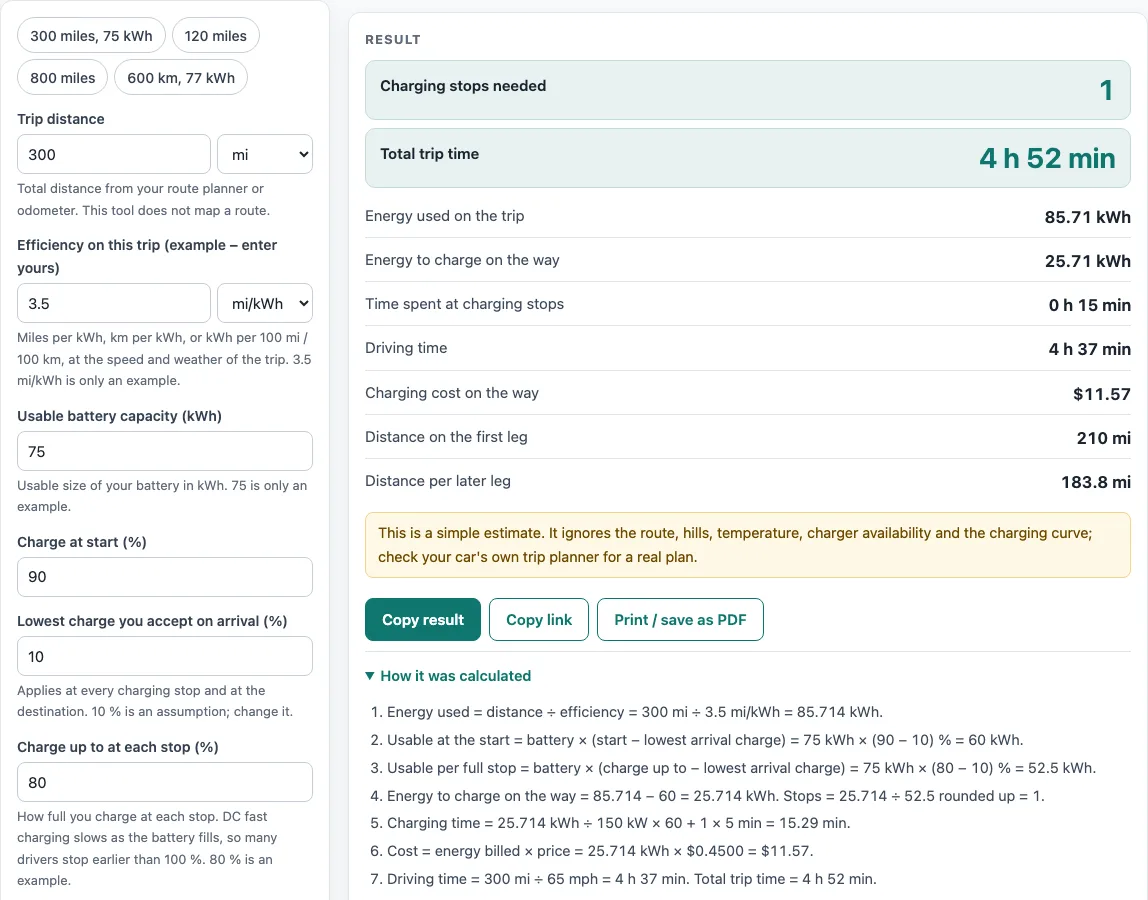
The example buttons above the form fill in sample trips (300 miles, 120 miles, 800 miles and 600 km in metric units). Under the results, How it was calculated shows each step with your numbers. You can Copy result, Copy link (the page address stores every input, so the calculation reopens later), or Print / save as PDF. Reset returns to the starting example.
How do you plan an EV trip?
Plan an EV trip by working out how much energy the distance needs, how much usable energy your battery gives you at the start and at each stop, and then how long and how much the charging takes. Start with trip energy: distance ÷ efficiency. A 300-mile trip at 3.5 mi/kWh needs about 85.7 kWh.
Usable energy depends on the charge levels you choose. At the start it is battery kWh × (start charge % − lowest arrival charge %). With a 75 kWh battery, a 90 % start and a 10 % arrival minimum, that gives 75 × 0.80 = 60 kWh. At each stop it is battery kWh × (charge-up-to % − lowest arrival charge %). Charging to 80 % gives 75 × 0.70 = 52.5 kWh per stop. The arrival minimum applies at every stop and at the destination, so it is always subtracted.
Time has two parts. Driving time is distance ÷ average speed, so 300 miles at 65 mph is about 4 h 37 min. Charging time is energy to add ÷ average charging power × 60, plus the minutes lost at each stop. Adding 25.7 kWh at an average of 150 kW takes about 10 min, and with 5 minutes lost per stop the total is about 15 min. Total trip time is driving time plus charging time, which gives 4 h 52 min for this example.
Cost works the same way: energy to add ÷ (1 − charging loss) × price per kWh. With no charging loss and a price of 0.45 per kWh, the same 25.7 kWh costs about $11.57.
How many charging stops does an electric car trip need?
An electric car trip needs as many stops as it takes to cover the energy the start charge cannot supply. Subtract the usable energy at the start from the trip energy, divide by the usable energy per stop, and round up. If the start charge covers the whole trip with the arrival minimum still met, no stop is needed.
For the 300-mile example, the trip needs 85.7 kWh. The start gives 60 kWh, which leaves 25.7 kWh. One stop worth 52.5 kWh covers that, so the result is 1 stop. For 800 miles at 3.5 mi/kWh starting at 100 %, the trip needs 228.6 kWh. The start gives 67.5 kWh, leaving 161.1 kWh. Each stop gives 52.5 kWh, so 161.1 ÷ 52.5 = 3.07, which rounds up to 4 stops.
Rounding up matters. A remainder of even a fraction of a stop still means one more stop. Charging to a higher level per stop reduces the count, but the last part of a fast charge takes longer per kWh, which the time estimate does not fully capture.
Worked examples
| Input | Result |
|---|---|
| 300 mi at 3.5 mi/kWh, 75 kWh battery, start 90 %, charge to 80 % | 1 stop(s), 4 h 52 min in total, $11.57 for charging on the way |
| 600 km at 17 kWh/100 km, 77 kWh battery, start 90 %, charge to 80 % | 1 stop(s), 5 h 48 min in total, €22.22 for charging on the way |
| 120 mi at 3.5 mi/kWh, 75 kWh battery, start 90 %, charge to 80 % | no stop needed, 44.29 % left on arrival |
| 800 mi at 3.5 mi/kWh, 75 kWh battery, start 100 %, charge to 80 % | 4 stop(s), 14 h 15 min in total, $72.48 for charging on the way |
Calculated by the tool above with these values.
Frequently asked questions
How long does an EV road trip take with charging?
Total time is driving time plus charging time. Driving time is distance ÷ average speed, and charging time is energy to add ÷ average charging power × 60, plus the minutes lost at each stop. With the example values, the 300-mile trip takes 4 h 52 min.
How much does an EV road trip cost in charging?
Charging cost is energy to add ÷ (1 − charging loss) × price per kWh. The 0.45 per kWh price is only an example, so replace it with the price your charging network bills. With the example values, the 300-mile trip costs $11.57 for charging on the way.
What does this calculator not do compared with a route planner?
It does not plan a route. There are no maps, no charger locations, and no elevation or weather data. It works only from the numbers you enter, so it cannot tell you whether a charger is available, working or on your path. Its warnings note that it ignores the route, hills, temperature and the charging curve. Check your car’s own trip planner for a real plan.
What do the warnings mean?
The tool shows warnings when the numbers suggest a problem. These include a start charge below your arrival minimum, legs under 20 miles, more than 10 stops, an average charging power above 400 kW, and a charge-up-to level above 90 %. Each one points to an input you should check, such as efficiency, battery size or charge levels.
Can I use the example values for my own car?
No. The 75 kWh battery, 3.5 mi/kWh efficiency, 150 kW charging power, 65 mph speed, 5 minutes per stop and 0.45 per kWh price are example values, not averages. The 10 % arrival minimum is an assumption. Enter your own battery size, expected efficiency, average charging power and local price for a result you can rely on.
Related tools
- EV range calculator: use it to estimate how far your car goes on the energy you have.
- EV charging time calculator: use it when you only need the time to charge a set amount of energy.
- EV efficiency calculator: use it to work out your real efficiency before you enter it here.
- EV cost per mile calculator: use it to compare running costs per mile across different charging prices.
- EV charging cost per kWh calculator: use it to find the price per kWh from a charging bill.
- EV charging cost calculator: use it to estimate the cost of charging a battery.
- All EV calculators: use it to browse every calculator on the site.
Sources
- Arithmetic on the figures you enter (energy = distance ÷ efficiency; time = energy ÷ power). No map, charger or price data is used; 1 mile = 1.609344 km (NIST SP 811).
- U.S. DOT, Charger types and speeds: DC fast-charging times are quoted to about 80 percent, which is why the calculator lets you set the charge-up-to level