EV Range Calculator
Enter the battery size, charge level and efficiency to estimate your electric vehicle's driving range.
The EV range calculator estimates how many miles or kilometres an electric vehicle can travel on its current charge. You enter your battery’s usable capacity, current charge, efficiency and the reserve you want to keep, and it works out the range. It runs in your browser, is free, and needs no sign-up.
Use it to plan a trip, compare how far a car can go at different efficiencies, or see how a cold-weather or highway estimate changes the result. The answer is only as good as the numbers you enter. Battery size and efficiency matter most, and the adjustment percentages are your own estimates.
How to use the EV range calculator
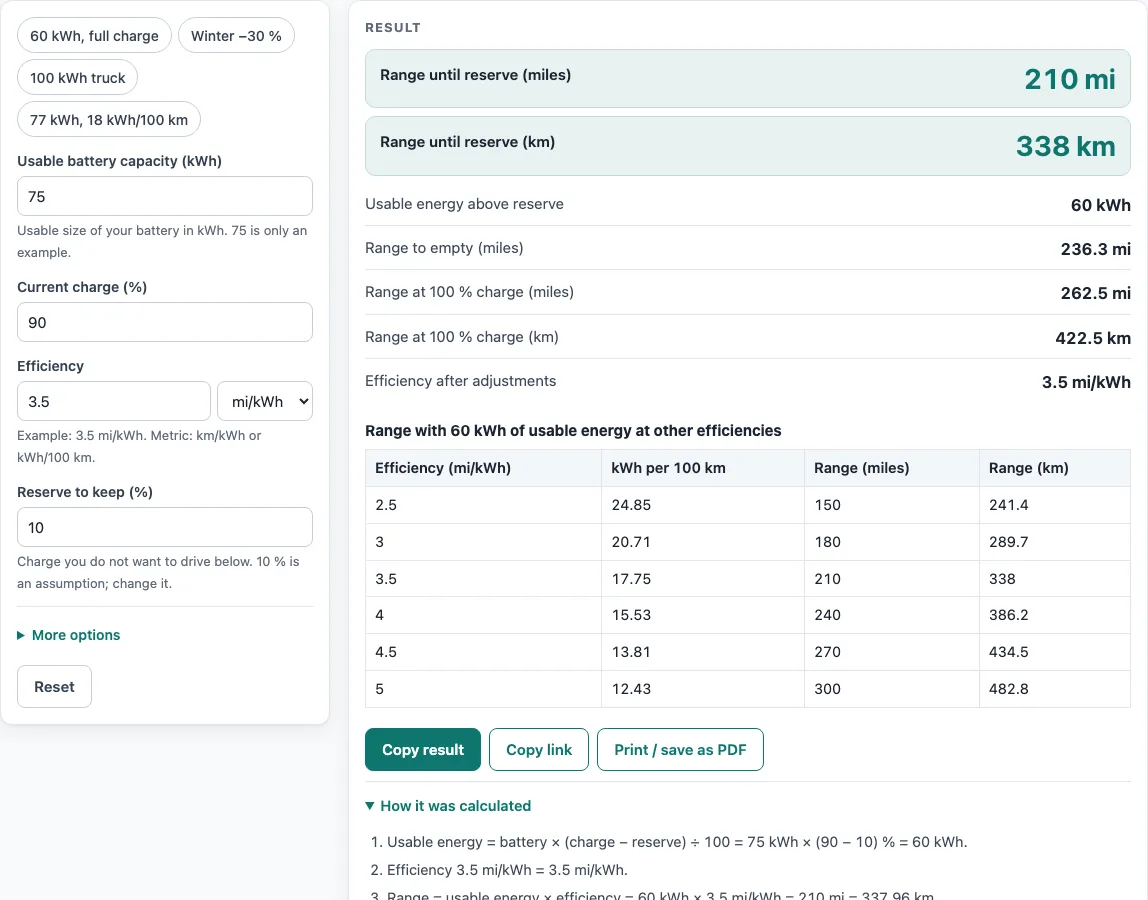
- Enter the usable battery capacity in kWh. The default of 75 kWh is only an example.
- Enter your current charge as a percentage.
- Enter your efficiency and pick its unit: mi/kWh, km/kWh, kWh/100 mi or kWh/100 km.
- Set the reserve you want to keep in the battery, as a percentage. The default is 10 %, an assumption you can change.
- Open More options if you want to add a cold weather, highway speed, or heating / air conditioning reduction. Each is a percentage you estimate, and 0 means none.
- Read the result rows: range until the reserve in miles and km, range to empty and range at 100 % charge. Check the table below for range at other efficiencies, from 2.5 to 5 mi/kWh, to see how much driving style matters.
- To start from a sample, press an example button: 60 kWh, full charge, Winter −30 %, 100 kWh truck, 77 kWh or 18 kWh/100 km.
Under the result, “How it was calculated” shows every step with your numbers. Copy result copies the result lines with a link, and Copy link stores all your inputs in the page address so the calculation reopens later. Print / save as PDF gives inputs, results, steps and the date. Reset restores the starting example.
How far can an electric car go on a charge?
An electric car can go as far as its usable battery energy allows, at the rate it uses that energy. Range depends on two things: how many kWh you can actually use, and how many kWh each mile or kilometre takes.
Because both figures vary by vehicle and by driving, the calculator asks for your own battery size and efficiency rather than giving one fixed answer.
How do you calculate EV range?
Multiply the usable battery capacity by the share of charge you can drive on, then by your efficiency. The calculator uses: range = usable kWh × (state of charge − reserve) × efficiency (mi/kWh), reduced by any adjustments you enter.
For example, a 75 kWh battery at 90 % with a 10 % reserve leaves 80 % of the battery to drive on. At 3.5 mi/kWh, that is 75 × 0.8 × 3.5 = 210 miles (about 338 km). Adjustments for cold weather, highway speed and heating or air conditioning are percentages you estimate. They are applied one after another, so each reduces the figure left by the one before.
How much range do EVs lose in winter?
Cold weather lowers efficiency, but the calculator does not contain a fixed winter figure. You enter your own estimate in the Cold weather reduction field, and 0 means no loss.
The Winter −30 % example button sets a 30 % reduction. Applied to the 210-mile example above, it gives 147 miles. Climate control is a separate field, so heating or air conditioning use can be added on top of the cold-weather estimate.
Why is my EV range lower than advertised?
The usable capacity of a battery can be less than its advertised size, so less energy is available to drive on. Enter the usable figure if you know it, because it is the number that drives the result.
Other factors also reduce range: the reserve you keep back, a charge below full, high speed, and climate control. The “Range at 100 % charge” row shows what a full charge would give, which helps you see how much of the gap comes from the charge level.
Worked examples
| Input | Result |
|---|---|
| 75 kWh battery at 90 %, 3.5 mi/kWh, 10 % reserve | 210 mi (338 km) of range |
| 75 kWh battery at 90 %, 3.5 mi/kWh, 10 % reserve | 147 mi (236.6 km) of range |
| 100 kWh battery at 100 %, 2.2 mi/kWh, 10 % reserve | 198 mi (318.7 km) of range |
| 77 kWh battery at 100 %, 18 kWh/100 km, 10 % reserve | 239.2 mi (385 km) of range |
| 60 kWh battery at 100 %, 4 mi/kWh, 5 % reserve | 193.8 mi (311.9 km) of range |
Calculated by the tool above with these values.
Frequently asked questions
Is the result an exact range?
No. The result is an estimate, and the note under every result says to verify critical designs against the applicable standard. The reductions are your own estimates, so the range is only as good as those numbers.
Why does the calculator show a warning about my efficiency?
A warning appears when the efficiency is below 1 or above 8 mi/kWh. Check the value and its unit, because a kWh/100 mi figure entered as mi/kWh (or the reverse) gives a very different result.
Can I use the results in a quote or service record?
Yes. Results, charts and printouts can be used freely in commercial work such as quotes, proposals, reports and service records, and no attribution is needed.
What happens if my charge is at or below the reserve?
The calculator shows a warning that the current charge is not above the reserve, so no usable range is left above the reserve. Raise the charge or lower the reserve to see a range.
Why keep a reserve?
Range estimates are never exact, and charging stops can be busy or out of order. The default 10 % reserve leaves a margin; set it to 0 to see the range to empty, which the result also shows.
Related tools
- EV efficiency calculator: use it when you need to work out your efficiency before entering it here.
- EV charging time calculator: use it to estimate how long it takes to add the charge you need for a trip.
- EV charging cost calculator: use it to estimate what a charge will cost.
- E-bike range calculator: use it to estimate range for an electric bike rather than a car.
- EV plug types chart: use it to check which plug your vehicle or charger uses.
- EV trip planning calculator: Use it when you want charging stops, time and cost for a longer trip.
- EV battery degradation calculator: use it to see how much capacity and range a battery keeps after some years.
- All EV calculators: use it to browse every calculator on the site.
Sources
- NIST SP 811: 1 mile = 1.609344 km, 1 US gallon = 3.785411784 L