EV Efficiency Calculator (EV Miles per kWh)
Convert between miles per kWh, kWh per 100 miles, km and MPGe, or work out your EV's efficiency from a trip.
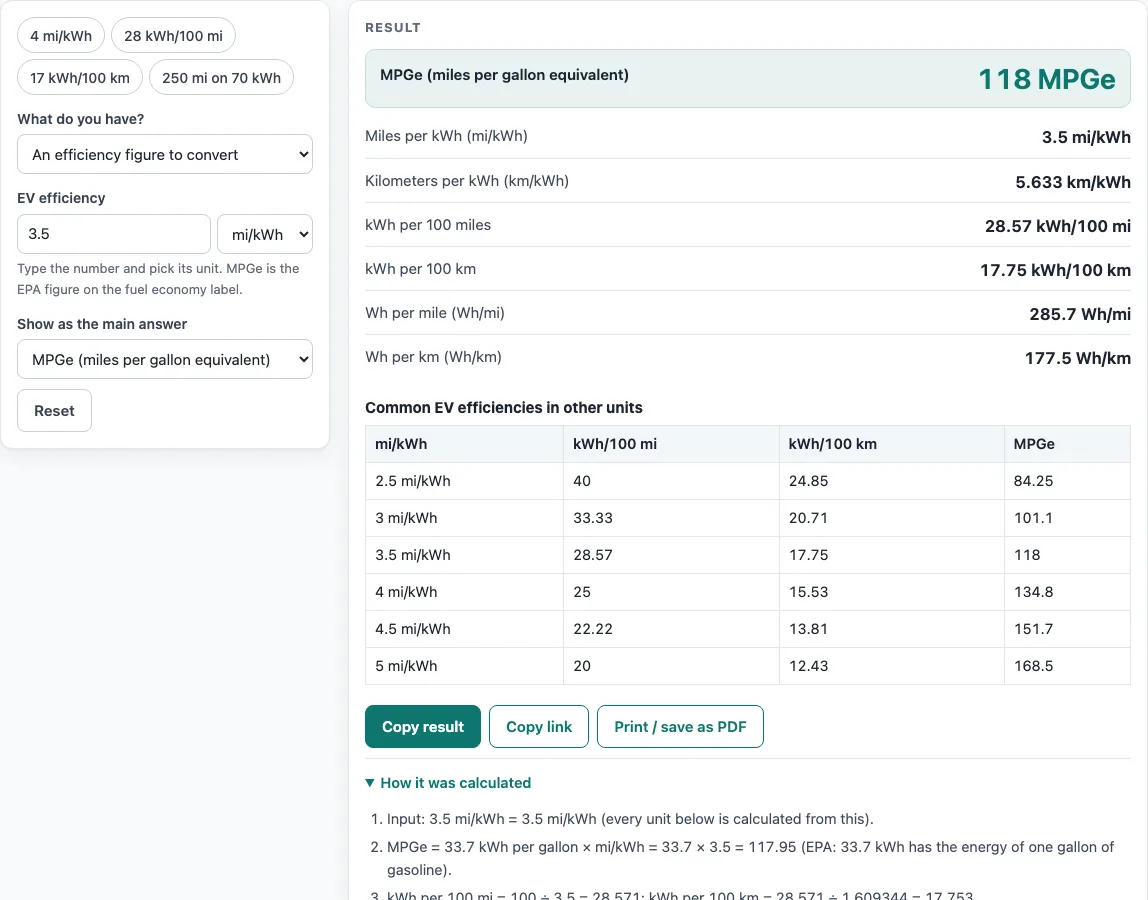
How to use the EV Efficiency Calculator
- Under “What do you have?”, choose An efficiency figure to convert or Distance driven and kWh used.
- If you chose an efficiency figure, type the number in EV efficiency and pick its unit: mi/kWh, km/kWh, kWh/100 mi, kWh/100 km, Wh/mi, Wh/km, or MPGe.
- If you chose distance and energy, type the distance in Distance driven and pick mi or km. Then type the energy in Energy used and pick kWh or Wh.
- Under Show as the main answer, pick the unit you want to see first, such as Miles per kWh or kWh per 100 miles.
- Read the result rows: every unit is shown at once, so you can copy whichever your car or a review uses.
- Open How it was calculated to see the formula and each step with your own numbers.
Use the example buttons above the form (4 mi/kWh, 28 kWh/100 mi, 17 kWh/100 km, or 250 mi on 70 kWh) to try the calculator before entering your own data. Copy result copies the result lines with a link, and Copy link saves every input in the page address, so the same calculation reopens later. Print / save as PDF includes your inputs, results, steps, and the date. Reset restores the starting example.
How many miles per kWh does an electric car get?
Efficiency depends on the car and on how it is driven, so there is no single answer. The calculator uses 3.5 mi/kWh as its example, which is about 118 MPGe. Your own figure comes from your car’s trip meter, or from a drive where you record the distance and the energy used. Cold weather, high speed, heating and cooling, and heavy loads all reduce efficiency, so compare figures recorded under similar conditions.
How do you convert kWh per 100 miles to miles per kWh?
Divide 100 by the kWh per 100 miles figure. Because miles per kWh and kWh per 100 miles are reciprocals, you can also divide 100 by miles per kWh to get kWh per 100 miles. For example, 28 kWh/100 mi gives 100 ÷ 28 = 3.571 mi/kWh, and 3.5 mi/kWh gives 28.6 kWh/100 mi.
To convert to metric units, use the distance in kilometers. Since 100 miles is about 161 km, 3.5 mi/kWh equals 17.8 kWh/100 km, and 4 mi/kWh equals 15.53 kWh/100 km. The tool does these steps for you and shows them under How it was calculated.
What is MPGe?
MPGe stands for miles per gallon equivalent. It expresses an EV’s efficiency in the same kind of figure as a gasoline car’s miles per gallon. The EPA treats 33.7 kWh of electricity as equal to one gallon of gasoline, so MPGe = 33.7 × mi/kWh.
At 3.5 mi/kWh, the result is about 118 MPGe. At 17 kWh/100 km, the result is 123.2 MPGe. The MPGe figure printed on the fuel economy label is the EPA value, and you can enter it directly in the EV efficiency input by choosing MPGe as the unit.
How do I calculate my EV’s efficiency?
Divide the distance you drove by the energy you used. The result is miles per kWh. For example, 250 miles on 70 kWh gives 250 ÷ 70 = 3.571 mi/kWh.
Decide which energy figure you want. Energy taken from the battery shows the car’s own efficiency. Energy measured at the wall includes charging loss, so the figure is lower. Use the same method each time if you want to compare drives.
Worked examples
| Input | Result |
|---|---|
| 3.5 mi/kWh | 118 MPGe |
| 4 mi/kWh | 15.53 kWh/100 km |
| 28 kWh/100 mi | 3.571 mi/kWh |
| 17 kWh/100 km | 123.2 MPGe |
| 250 mi on 70 kWh | 3.571 mi/kWh |
Calculated by the tool above with these values.
Frequently asked questions
Why is my EV’s efficiency lower in winter?
Cold weather and heating both reduce efficiency. A winter drive can show fewer miles per kWh than a mild-weather drive of the same route.
Does the calculator have a list of car models?
No. There is no car-model database, so enter the figure for your car yourself. This applies to a Tesla Model Y, Model 3, Chevy Bolt, Nissan Leaf, or any other EV, using a trip meter reading or a measured drive.
Can I use the results in a quote or report?
Yes. Results may be used freely in commercial work such as quotes, proposals, reports and service records, and no attribution is needed. The note under each result still applies: it is for estimation, so verify critical designs against the applicable standard.
Is my data uploaded anywhere?
No. The calculator runs entirely in your browser, nothing is uploaded, and no sign-up is required.
Can I enter distances in kilometers?
Yes. Choose km under Distance driven, or pick km/kWh or kWh per 100 km as the main answer. The result rows will show the matching units.
Why does my EV use more energy in winter?
Cold batteries are less efficient, the cabin and battery need heating, and winter tyres and denser air add resistance. Measure a winter trip with the distance-and-energy mode to see your own figure.
Related tools
- EV range calculator: Use it to estimate how far your EV can travel on a given battery energy.
- EV charging cost calculator: Use it to estimate what a charging session costs.
- EV cost per mile calculator: Use it to compare what each mile costs to drive in an EV.
- EV vs gas calculator: Use it to compare running costs between an electric car and a gasoline car.
- EV charging time calculator: Use it to estimate how long a charge will take.
- All EV calculators: Use it to browse every calculator on the site.
Sources
- EPA, Fuel economy and EV range testing: 33.7 kWh per gallon equivalent (MPGe)
- NIST SP 811: 1 mile = 1.609344 km, 1 US gallon = 3.785411784 L