EV Charger Wire Size and Breaker Calculator
Enter the charger current and run length to get the breaker size, the minimum wire ampacity and the gauge for voltage drop.
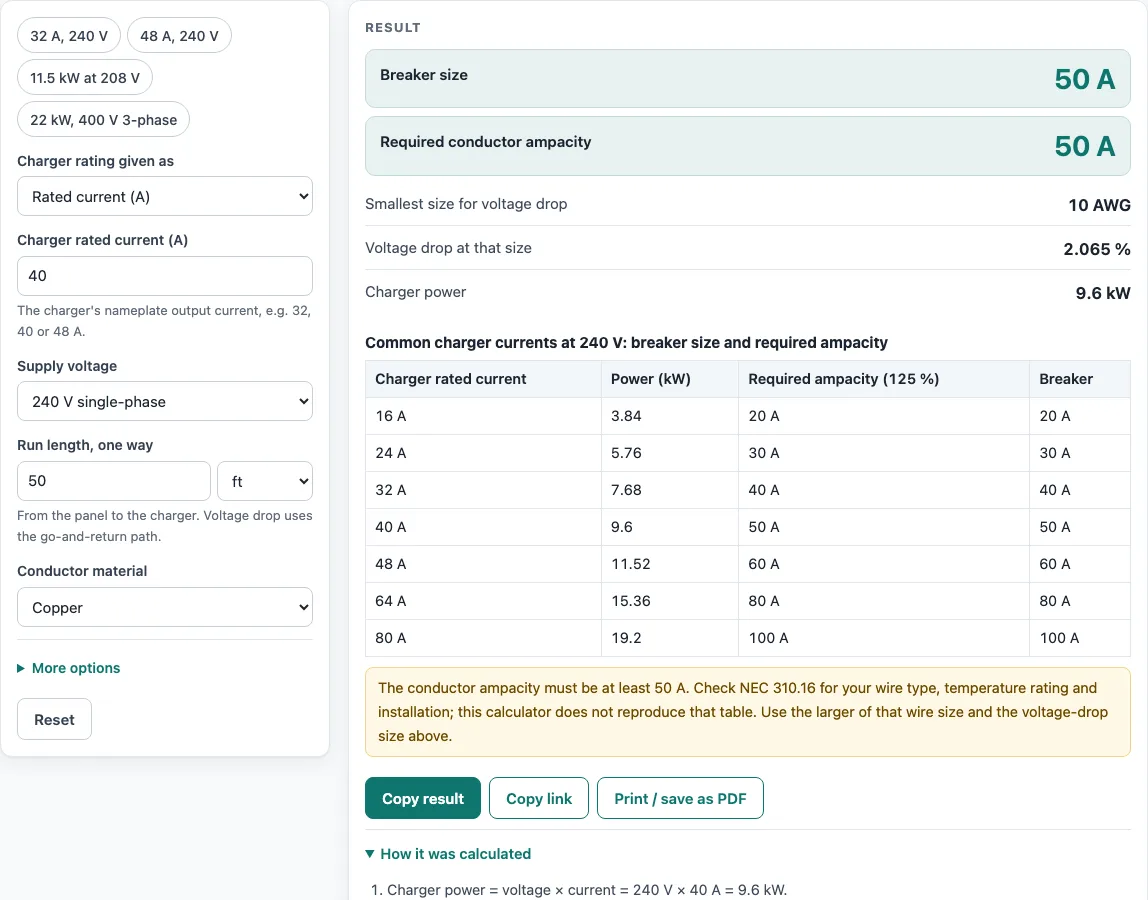
How to use the EV charger wire size calculator
- Open the “Charger rating given as” drop-down and choose Rated current (A) or Power (kW).
- If you chose rated current, enter the nameplate output current in “Charger rated current (A)”, for example 32, 40 or 48 A. If you chose power, enter the figure in “Charger power (kW)”.
- Pick the “Supply voltage”: 240 V single-phase, 208 V single-phase, 400 V three-phase or 480 V three-phase.
- Enter the “Run length, one way” and select ft or m. Measure from the panel to the charger.
- Select the “Conductor material”: Copper or Aluminum.
- Open “More options” if you need to change “Allowed voltage drop (%)” (default 3 %) or “Conductor temperature (°C)” (use the terminal rating of your breaker and charger, 60 °C or 75 °C, NEC 110.14(C)).
- Read the result rows that apply to your mode, then check any warning shown above them.
- Scroll to “How it was calculated” to see every step with your numbers.
The example buttons above the form load ready-made cases, including 32 A at 240 V, 48 A at 240 V, 11.5 kW at 208 V, 22 kW, and 400 V three-phase. Copy result gives you the result lines with a link. Copy link stores every input in the page address, so the same calculation reopens later. Print / save as PDF includes your inputs, results, steps and the date. Reset returns the form to the starting example.
What size wire do I need for an EV charger?
You need the larger of two sizes: the wire that meets the required ampacity, and the wire that keeps voltage drop within your limit. The calculator finds the smallest AWG that stays within your voltage-drop limit for your run length, using conductor resistance at 75 °C. It then shows the ampacity the wire must carry. The calculator does not reproduce NEC Table 310.16, so check that table for your wire type, temperature rating and installation. Where the ampacity check gives a larger wire, use that one. On short runs the ampacity requirement usually decides: the default 40 A charger at 50 ft passes the voltage-drop check with 10 AWG, but the conductor must also be rated for 50 A, which the table check settles.
What size breaker for a 40 amp EV charger?
A 40 A charger needs a 50 A breaker. NEC 625.41 requires the branch circuit and its overcurrent protection to be rated at least 125 % of the charger’s rated current. Multiplying 40 A by 1.25 gives 50 A, which is a standard breaker size under NEC 240.6(A). The conductors must also have at least 50 A ampacity.
Why is an EV charger sized at 125 %?
EV charging is a continuous load, meaning the charger can run at full output for three hours or more. Breakers and wiring heat up under sustained current, so the NEC asks for extra capacity. Sizing the circuit at 125 % of the charger’s rated current keeps the breaker and conductors at or below 80 % of their rating while the charger runs at full output. The margin is applied to the charger’s rated current, not to the breaker size you choose afterwards, so the breaker can be the next standard size up.
What size wire for a 48 amp charger?
A 48 A charger needs a 60 A breaker, because 48 A times 1.25 is 60 A. The conductors must have at least 60 A ampacity. The voltage-drop size depends on run length. A 48 A charger on 240 V with 100 ft of copper gives a 60 A breaker, 60 A ampacity and 6 AWG for voltage drop. Check the ampacity requirement in NEC Table 310.16 and use the larger of the two wire sizes.
Worked examples
| Input | Result |
|---|---|
| 40 A charger on 240 V, 50 ft of Copper | 50 A breaker, 50 A ampacity, 10 AWG for voltage drop |
| 32 A charger on 240 V, 75 ft of Copper | 40 A breaker, 40 A ampacity, 10 AWG for voltage drop |
| 48 A charger on 240 V, 100 ft of Copper | 60 A breaker, 60 A ampacity, 6 AWG for voltage drop |
| 11.5 kW charger on 208 V, 60 ft of Copper | 70 A breaker, 69.11 A ampacity, 8 AWG for voltage drop |
| 32 A charger on 400 V, 30 m of Copper | 40 A breaker, 40 A ampacity, 12 AWG for voltage drop |
Calculated by the tool above with these values.
Frequently asked questions
Should I choose copper or aluminum for my EV charger wire?
Aluminum needs a larger size than copper for the same current, so the calculator shows a bigger wire when you select Aluminum. Aluminum terminals must be identified for aluminum under NEC 110.14. Run the calculation for both materials to compare the sizes before you decide.
What if my run is very long?
If no copper or aluminum size up to 1000 kcmil keeps voltage drop within your limit, the calculator shows a warning. Shorten the run or raise the supply voltage. Runs longer than about 150 m (500 ft) need careful design, so ask an electrician for advice.
Can I enter kilowatts instead of amps?
Yes. Choose Power (kW) in “Charger rating given as” and enter the figure in “Charger power (kW)”. The calculator uses kW = volts × amps, so a 240 V × 40 A charger is 9.6 kW.
Can I raise the allowed voltage drop above 3 %?
You can, but the default 3 % is the value the informational notes to NEC 210.19 and 215.2 recommend for a branch circuit. If you enter more than 5 %, the calculator warns you that this is above the recommended level.
Can I use the results in a quote or a service record?
Yes. Results may be used freely in quotes, proposals, reports and service records, and no attribution is needed.
Related tools
- EV charger load calculator: use it to work out the total electrical load when a charger shares a supply with other equipment.
- EV charging time calculator: use it to estimate how long a charge takes at your charger’s power.
- EV plug types chart: use it to check which connector matches your vehicle and charger.
- EV charging cost calculator: use it to estimate what each charging session costs in electricity.
- EV range calculator: use it to estimate how far your vehicle can travel on a full charge.
- Level 2 charger amps calculator: use it to turn charger amps into kW and range per hour, or to find the largest charger a breaker allows.
- All EV calculators: use it to browse every calculator on the site.
Sources
- NFPA 70, National Electrical Code: sections 625.41, 220.57, 220.87, 240.6(A), 110.14(C) cited; no tables reproduced
- NBS Handbook 100 and Handbook 109: copper and aluminium resistivity