EV Charger Load Calculation (Panel Capacity)
Enter your service size and existing demand to see whether an EV charger fits and the largest charger current your panel can take.
This load calculation for an EV charger checks whether your home’s electrical service has enough spare capacity for a new EV charger. Enter your service size, your existing load, and the charger’s rated current, and it shows the total load, the spare capacity, and the largest charger current that fits. It runs in your browser, is free, and needs no sign-up. The calculation follows the EV charger rule in NEC 220.57 and the existing-dwelling method in NEC 220.87. The result is a planning estimate, so an electrician and the local authority having jurisdiction make the final decision.
It follows NEC 220.57 for the charger load and NEC 220.87 for measured demand.
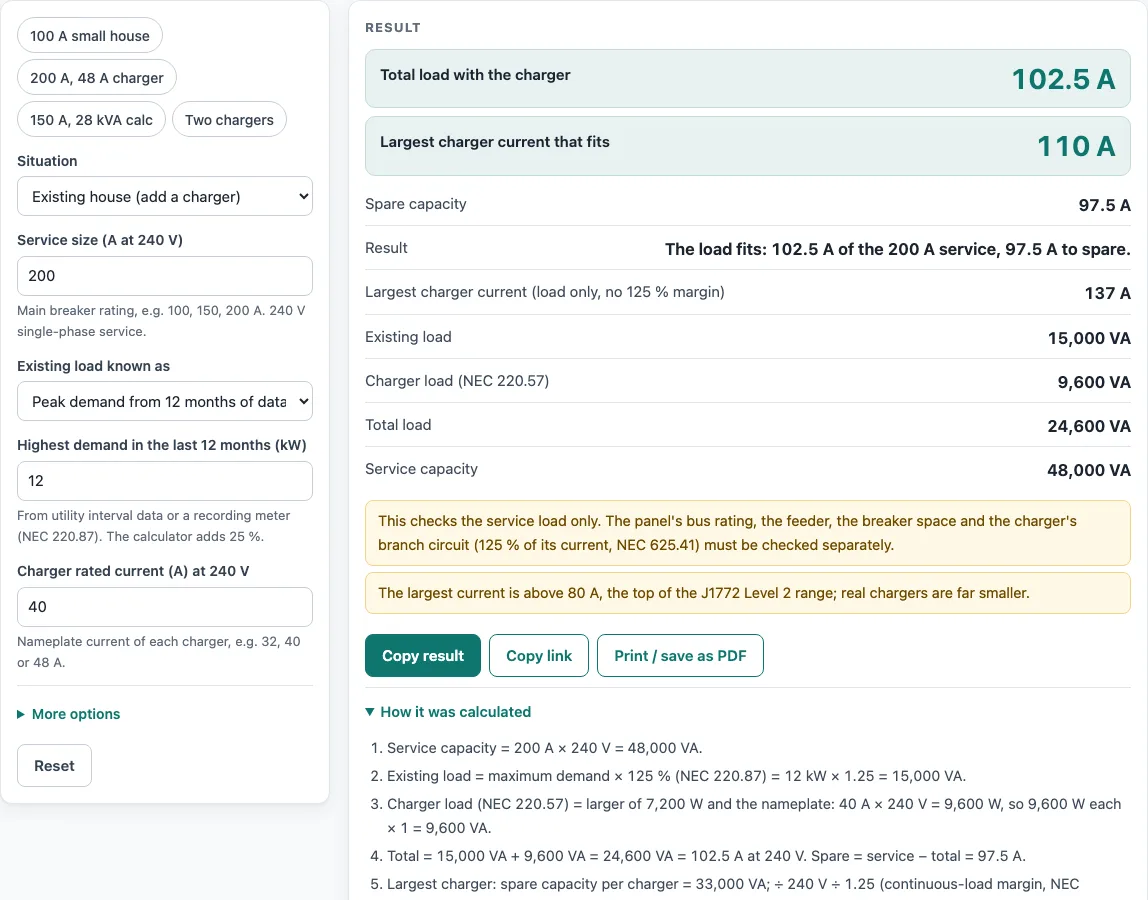
How to use the EV Charger Load Calculator
- Choose Situation: “Existing house (add a charger)” or “New dwelling (calculated load).”
- Enter Service size (A at 240 V). This is the main breaker rating, such as 100, 150 or 200 A.
- If it is shown, set Existing load known as to “Peak demand from 12 months of data (kW)” or “Calculated load (VA).”
- For peak demand, enter Highest demand in the last 12 months (kW). Use utility interval data or a recording meter reading.
- For a calculated load, enter Calculated load in VA or kVA. Leave out the charger, because the calculator adds it.
- Enter Charger rated current (A) at 240 V from the charger’s nameplate.
- Under More options, set Number of chargers if you plan more than one.
- Read the results: Total load with the charger, Spare capacity, Largest charger current that fits, and Result.
- Open How it was calculated to see each step with your own numbers.
The example buttons above the form load sample setups, such as a 200 A service with a 48 A charger. Copy result copies the result lines and a link. Copy link stores every input in the page address, so you can reopen the same calculation later. Print / save as PDF includes the inputs, results, steps and the date. Reset restores the starting example.
Can my panel handle an EV charger?
Your service can handle the charger when the existing load plus the charger’s load fits within the service capacity. This tool checks the service load, not only the panel’s size.
Service capacity in VA is service amps × 240 V, so a 200 A service is 48,000 VA. The charger counts as 7,200 W or its nameplate rating, whichever is larger (NEC 220.57). The bus rating, the feeder, the breaker space and the charger’s own branch circuit must be checked separately.
How do you do a load calculation for an EV charger?
Add the existing load to the charger load, then compare the total with the service capacity. A measured peak is increased by 25 % before it is added.
Example: a 200 A service with a 12 kW measured peak. 12 kW × 1.25 = 15 kW. A 40 A charger at 240 V is 9.6 kW. The total is 24.6 kW, which is 102.5 A (24,600 ÷ 240). The spare capacity is 200 − 102.5 = 97.5 A. The largest charger that fits is (48,000 − 15,000) ÷ 240 ÷ 1.25 = 110 A. The 1.25 in that last figure applies the 125 % margin for a continuous load.
Do I need a 200 amp service for an EV charger?
Not always. Whether 200 A is needed depends on your existing load and the charger’s size, and the calculation shows the answer.
In one example, a 150 A service has a 28 kVA calculated load and a 40 A charger. The total is 156.7 A, which is 6.667 A over the 150 A service. The largest charger that fits is 26 A. When a charger does not fit, the usual options are a smaller charger, a service upgrade, or an energy management system that limits the charger’s load (NEC 625.42 and 750.30).
What is NEC 220.87?
NEC 220.87 is the method for finding the existing load of a dwelling from its maximum demand over the last 12 months. It is used when you add load to an existing home.
If the existing load comes from a measured peak, that peak is increased by 25 %. The new load is then added, and the total is compared with the service capacity.
Worked examples
| Input | Result |
|---|---|
| 200 A service, 12 kW measured peak, 1 × 40 A charger | 102.5 A total, 97.5 A spare, up to 110 A charger |
| 100 A service, 8 kW measured peak, 1 × 32 A charger | 73.67 A total, 26.33 A spare, up to 46 A charger |
| 200 A service, 12 kW measured peak, 1 × 48 A charger | 110.5 A total, 89.5 A spare, up to 110 A charger |
| 150 A service, 28 kVA calculated load, 1 × 40 A charger | 156.7 A total, -6.667 A spare, up to 26 A charger |
| 200 A service, 12 kW measured peak, 2 × 40 A charger | 142.5 A total, 57.5 A spare, up to 55 A charger |
Calculated by the tool above with these values.
Frequently asked questions
Does this calculator replace an electrician’s check?
No. The result is a planning estimate, and the electrician and the authority having jurisdiction make the decision. The page also notes that critical designs should be verified against the applicable standard.
Why does the calculator warn about a charger current above 80 A?
An 80 A charger is at the top of the J1772 Level 2 range (80 A at 240 V). A warning like this may mean a value was entered in the wrong unit, so check the inputs.
Do I need a 200 amp service for an EV charger?
Not necessarily. A 100 A or 150 A service may be able to take a smaller charger if the existing demand is low; the result shows the spare capacity and the largest charger current that fits. If it does not fit, a load-management device or a smaller charger may avoid an upgrade.
What if my measured peak is higher than the service capacity?
The calculator shows a warning. Check that the number is in kW, not kWh, because kWh is an energy figure and gives a much smaller result.
Can I use the results in a quote or service record?
Yes. Results, charts and printouts can be used freely in commercial work such as quotes, proposals, reports and service records, and no attribution is needed.
Is my data uploaded anywhere?
No. The calculator runs in your browser, and nothing is uploaded. There is no sign-up, and the tool is free.
Related tools
- EV charger wire size: Use it to choose the conductor size for your charger’s circuit after you know the charger’s current.
- EV charging time calculator: Use it to estimate how long a charge will take at a given power level.
- EV plug types chart: Use it to identify the connector your car and charger need.
- EV charging cost calculator: Use it to estimate what charging costs with your electricity rate.
- EV range calculator: Use it to estimate how far your car can travel on a charge.
- All EV calculators: Use it to browse every calculator on the site.
Sources
- NFPA 70, National Electrical Code: sections 625.41, 220.57, 220.87, 240.6(A), 110.14(C) cited; no tables reproduced
- Power Monitors, Recording for NEC 220 compliance: NEC 220.87 maximum demand at 125 %