Ebike Range Calculator
Enter the battery voltage and amp-hours and your consumption to estimate how far your e-bike goes on a charge.
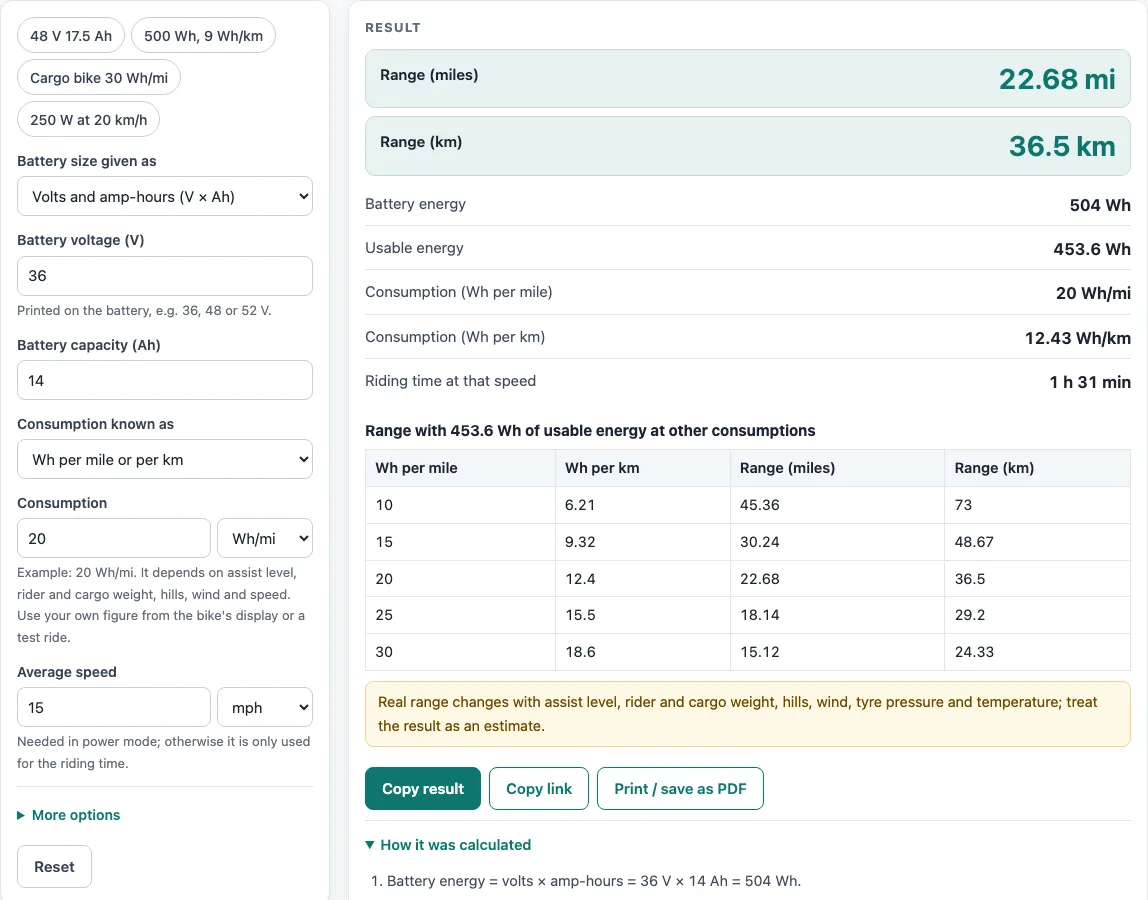
How to use the e-bike range calculator
- Choose Battery size given as. Pick “Volts and amp-hours (V × Ah)” if the battery shows volts and amp-hours, or “Watt-hours (Wh)” if it shows watt-hours.
- If you chose volts and amp-hours, enter Battery voltage (V), printed on the battery (for example 36, 48 or 52 V), and Battery capacity (Ah). If you chose watt-hours, enter Battery energy (Wh) directly.
- Choose Consumption known as. Pick “Wh per mile or per km” if you have a figure from your bike’s display or a test ride. Pick “Average power and speed” if you know the motor’s average power.
- For “Wh per mile or per km”, enter Consumption and choose its unit (Wh/mi or Wh/km). For “Average power and speed”, enter Average motor power (W) and Average speed, choosing mph or km/h.
- Open More options and check Usable battery (%). It is 100 %, the rated energy; lower it if your bike keeps a reserve.
- Read the result rows: Range (miles), Range (km), Battery energy, Usable energy, Consumption and Riding time at that speed. Only the rows that match your mode appear.
- Check the table of ranges and “How it was calculated”.
The example buttons above the form load ready-made inputs, and Reset returns the form to the starting example. Copy link stores every input in the page address, so the same calculation reopens later. Print / save as PDF produces a copy of the inputs, results, steps and date. Copy result copies the result lines with a link.
How far can an e-bike go on one charge?
An e-bike goes as far as its usable battery energy allows, divided by how much energy it uses per mile or kilometre. A 36 V 14 Ah battery stores 504 Wh, and at 20 Wh per mile with all of it used, it gives about 25.2 miles; if you keep 10 % in reserve (90 % usable), about 22.7 miles. Real rides can be shorter or longer, depending on how you ride and what you carry.
How do I calculate e-bike range?
Divide usable energy by consumption. The formula is Range = usable Wh ÷ consumption (Wh per mile or per km). Work through it in three steps:
- Battery energy (Wh) = volts × amp-hours. For 36 V × 14 Ah, that is 504 Wh.
- Usable energy = battery energy × usable fraction. At 90 %, 504 × 0.9 = 453.6 Wh.
- Range = usable energy ÷ consumption. At 20 Wh per mile, 453.6 ÷ 20 = 22.68 miles, or about 36.5 km.
If you know the average motor power and speed instead, use Wh per mile = average power (W) ÷ average speed (mph). A motor drawing 250 W at 20 km/h (about 12.4 mph) uses about 20 Wh per mile, so the same battery gives about 22.55 miles.
How many Wh per mile does an e-bike use?
The calculator asks you to double-check values below 5 or above 60 Wh per mile, which usually means a unit mix-up. It uses 20 Wh per mile only as an example value. The most accurate figure for your bike is the one shown on its display after a ride, or the usable Wh divided by the miles you covered on a full charge. To convert to Wh per km, divide the Wh per mile value by 1.609.
What affects e-bike range?
Consumption, and therefore range, depends on several factors. The assist level you use has a large effect, because a higher level draws more power from the battery. Rider and cargo weight matter, since more mass needs more energy to move. Hills, headwinds, and higher speeds all increase energy use. Tyre pressure and temperature also change how far the battery goes. A heavy cargo bike at 30 Wh per mile on a 48 V 20 Ah battery gives about 28.8 miles, while the same battery at 20 Wh per mile gives about 43 miles, so the riding conditions can change the result a lot.
Worked examples
| Input | Result |
|---|---|
| 36 V × 14 Ah, 100 % usable, 20 Wh/mi | 25.2 mi (40.56 km) of range |
| 48 V × 17.5 Ah, 100 % usable, 20 Wh/mi | 42 mi (67.59 km) of range |
| 500 Wh, 100 % usable, 9 Wh/km | 34.52 mi (55.56 km) of range |
| 48 V × 20 Ah, 100 % usable, 30 Wh/mi | 32 mi (51.5 km) of range |
| 36 V × 14 Ah, 100 % usable, 250 W at 20 km/h | 25.05 mi (40.32 km) of range |
Calculated by the tool above with these values.
Frequently asked questions
Is the calculator result exact?
No. The result is an estimate based on the consumption and usable battery figures you enter. Real range changes with assist level, load, terrain, wind, tyre pressure and temperature.
What does the usable battery percentage do?
It sets the share of the battery’s stored energy that the calculation counts as available. The default is 100 %, the battery’s rated energy; lower it if your battery management keeps a reserve or you stop before the battery is flat. Values below 50 % are flagged as low, so check the value you enter.
Can I use the results in a quote or report?
Yes. Results, charts and printouts can be used freely in commercial work such as quotes, proposals, reports and service records, and no attribution is needed. For critical designs, verify the figures against the applicable standard, as the note under each result says.
Why does the calculator show a warning?
A warning means one of your values looks unusual. Consumption below 5 or above 60 Wh per mile, or a battery voltage above 100 V, is flagged so you can check the number and its unit. A warning does not stop the calculation.
Does a bigger battery always mean more range?
More watt-hours give more range at the same consumption, but a heavier battery and faster riding raise the Wh per mile a little. Compare batteries by Wh (volts × amp-hours), not by Ah alone: a 48 V 14 Ah pack holds 672 Wh, a third more than a 36 V 14 Ah pack.
Related tools
- EV range calculator: Use it to estimate how far a full electric car can drive on one charge.
- EV efficiency calculator: Use it to work out energy use per distance for an electric vehicle.
- EV charging time calculator: Use it to estimate how long a battery takes to charge at a given power.
- EV charging cost calculator: Use it to estimate what a charging session costs.
- All EV calculators: Use it to browse every calculator on the site.
Sources
- NIST SP 811: 1 mile = 1.609344 km, 1 US gallon = 3.785411784 L